Welcome to Ghana

Welcome to Ghana

Sunday, September 11, 2016

Cape Coast Festival


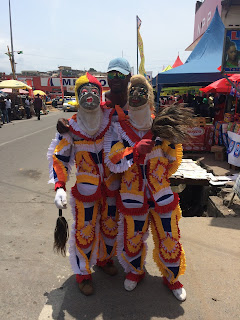
Last weekend we went to part of a six week long festival in the beautiful oceanside city of Cape Coast. The Afahye festival, celebrated by the Fantis (a group of people native to Southern Ghana, originated as a result of a severe epidemic. The festivals purpose is to clean the lives of people as well as the town. It also is a New Years Eve celebration because the main weekend of the festival marks the New Year for the Fante.


Ritual events at the festival consist of many different activities such as the confinement of the King, cleansing rituals with physical activities, the slaughtering of a bull, and dances where priests and priestesses can become possessed by spirits.


The bull is thought of as being the largest domesticated animal that one can sacrifice. In past years, University of California Education Abroad Students (UCEAP) have made attempts to let the bull free or to buy the bull to no prevail. It is being sacrificed for the sins of the people.


Part of the celebration during the festival includes a huge parade where all of the chiefs in Ghana come together with members of their tribes. The festival helps to renew political bonds between the King and other sub-chiefs. It also facilitates interaction between the government and people at the local level. 


Cape Coast, which usually has a population of about 170,000, swells to just over one million people every year for the slaughter and parade. Naturally this makes the nightlife scene very chaotic.


The weekend was a great cultural experience, be sure to check out the festival if you’re ever in Ghana for it!
Random Fun Fact: Sometimes avocados are purple in Ghana!


Thursday, September 1, 2016

Ghanaian Kente Cloth and Adinkra Symbols

Adinkra Stamps

A few weeks back all of the University of California Education Abroad (UCEAP) students visited two villages outside of Kumasi (about four hours away from Accra) where we learned how to make Kente cloth, and had the opportunity to stamp our own Adinkra cloths. Kente cloth is intricately woven fabric that has become the symbol of Africa for African nations and Adinkra symbols are a unique art of printing dating back to the 13th century. Both of these cloths originated in Ghana. 

All of the symbols have a different meaning, which can be seen by clicking HERE. The combination of different symbols can relay different messages. 

Before the cloth can be stamped, the ink has to be created. It is made from a special type of bark, and the entire process of ink making takes a couple weeks. The first stage is flattening the bark by smashing it repeatedly with a stick. 


Smashed Bark for Ink
After the bark has been flattened, it gets heated up over several days and eventually turns into a form of ink. All of the students were fortunate enough to be able to chose two symbols and stamp our cloths. As a new Rotarian, I decided to chose symbols that correspond with my Rotarian values. (If you don’t know what a Rotarian is, be sure to check out THIS link!) The symbol (sort of) resembling a ladder symbolises a snake climbing a raffia tree. It means “doing something impossible and being persistent” or never giving up. The symbol consisting of multiple circles is a warning against bossiness and symbolises exhorting humility and servitude in others. 


Adinkra Symbols Stamped onto Cloth


We also had the pleasured of learning how to make Kente cloth, which is a very strenuous process. After purchasing and dying the thread (all of it comes white),  it needs to be spooled (While its possible to buy string that has already been spooled, its much to expensive for the villagers.) 


Spooling the Thread
After, they have to create the base for their Kente cloth, which they do by walking the spooled string back and forth multiple times between two pegs. 


Afterward, they bring the base to the loom. The looms are both awesome and very intricate. After attaching the base to the loom, they weave a second spool of thread back and forth through the loom to create different patterns.


The process can take anywhere from a couple of days to over a month. Although in the United States sewing, weaving, and related crafts are often thought as things that “women do”, it is customary for men to be the only ones who weave Kente cloth. Women are allowed to make them however, they are not allowed to sell the cloths they create. 


I purchased a triple woven (extra durable) Kente cloth for 130 cedi (approximately $32) which I can have made into a dress. In the meantime, it makes a great blanket. 

Tuesday, August 23, 2016

First Day of School!

(Written August 22nd, retroactively posted internet permitting!)

In my 17 years of school, I have never had a first day like today. The day started out like every other first day. I woke up, got ready, and even took my “first day” photo! 


I had no idea where my classes were because acronyms were used for all of the buildings. For example, I was supposed to go to LLT, but because none of the Ghanaians I spoke with have taken a linguistics course before, none of them knew where the lecture hall was. After some wandering and some very helpful locals, I learned that LLT stands for Linguistics Lecture Theatre. (Keep in mind this was all happening before 7:30 AM because my class was scheduled to start at 7:30 AM.)

Finally I found the classroom… only to find it empty. Later I learned it is totally normal for professors not to show up for class in the first week of the semester, but it is still the duty of the students to sit in the lecture hall for the first 45 minutes of the lecture period in case the class does occur. I was scheduled to have four classes today, but only one of them took place. Some of them do not even have assigned locations yet, even though we are in the first week of school. Like I said, it was a first day unlike any other. 

I’m accustomed to living in California, where time is money, but here in Ghana time is simply time. In Ghana it is senseless to go to a restaurant hungry because on average they take such a long time to bring food that you would be ravenous by the time the food got there. I find this is simply because Ghanaian food takes a long time to prepare. In California there is a saying, “Patience is a virtue.” Well in Ghana it’s a necessity. It’s hard moving from a culture where everything needed to be done yesterday to a culture where things can simply be done tomorrow, but it is most definitely a way to learn patience, which is a skill I’m still establishing. 


I found this photo in a coffee shop the other day, it’s very appropriate for the region. 

In the Beginning...

Hey Everyone! Just got internet access on the laptop for the first time since arriving!

(Written August 8th, retroactively posted internet permitting!)

After 30+ hours of traveling and three flights, we finally arrived save and sound in Accra! We arrived at 5:10 AM local time, and the humidity was so high (100%) that it felt like we covered ourselves in maple syrup and never washed it off. The heat I can handle, but the humidity will take a lot of getting used too. 

Here are five truths about Ghana/Ghanian culture that I have learned in the past 15 hours:

  1. Back in the day, before the wonderful invention of toilet paper, people used their left hand to wipe. Although we have the ever so famous TP (or T-Roll, as they say) here in Ghana now, the tradition still stands and it is incredibly rude to do anything with one’s left hand including daily things such as eating, paying, or gesturing. Fortunately for me, writing with it is okay though!
  2. The University of Ghana Legion’s men’s handball team is ranked #1 in the country. They haven’t lost a match in six years.
  3. University of Ghana is home to the largest library in West Africa, the “” library.
  4. The pineapple juice here is delicious. I’ve only been here a day and I’m positive I’m going to miss it like crazy when we leave in December.
  5. Ghanians live up to their reputation of being extremely friendly. They are very welcoming.

Tomorrow the two week long culturally intense orientation/immersion program begins. The next two weeks have been mapped out down to every second of every day. We will be learning basic skills such as how to do our laundry, how to eat healthy in Ghana, how to perform African drumming and dancing, and how to speak Asante Twi phrases as well as traveling around the country to places such as Kumasi, and Cape Coast. The orientation is so intense that we get four quarter units for it. (To give some perceptive, at UCLA I would get five quarter units for attending one class for five hours every week for 10 consecutive weeks.)


Time to use what little free time I have to sleep! Good night!


Friday, August 5, 2016

I'm Engaged! Well... Sort Of...

Actually I'm not engaged at all. But I do have my faux engagement ring... a lovely sterling silver ring that I bought for $20. According to numerous sources (including the internet, advice from strangers, and my travel nurse) it is strongly recommended that I wear a "wedding type ring" to limit the number of proposals I'll get on the street. Maybe one day while strolling through Accra (pronounced: uhh-KRAW, or for those linguists out there: [əˈkrɑː]) I'll take it off to see how many (more) wedding proposals I get on the street. Think I'm joking? Check out this post from Pink Pangea titled: "How to Reject Marriage Proposals From Ghanaian Men." (1)


Tomorrow's the day folks! And let me tell you, it really hasn't hit me yet. Other than the fact that my entire life is packed into a giant backpack and a duffel bag, life feels pretty normal. Just working, going out to dinner with friends. You know... normal stuff. But tomorrow, as we embark on our first of three flights to JFK airport, it will all change. All the research and built up excitement from the past year will hit me and once again I will embark on another journey that is not simply "a year of my life" but rather my entire life in one year. Again, I will experience all of the stages of language acquisition that children experience. Beginning from virtually nothing, I will attempt to learn enough Twi (pronounced: tchree, linguists: [tʃwiː]) to haggle at markets and order food at restaurants. Fortunately for me, English is the official language of Ghana; however, Twi is the most widely spoken language (2).  

Pretty soon I'll be sure to provide for you, my lovely readers, a list of things that are in fact NOT weird. Simply different between Ghana and my beautiful home state California. (A lovely Rotary Youth Exchange motto right there! Not weird, just different.) 

In the mean time have any questions? Concerns?! Thoughts? Insights? Or any other type of remark? Be sure to leave it in a comment below!

Now... let's get this adventure started!

P.S. Here's a picture of my dog Chrissy, simply because (like every dog owner) I think she's absolutely adorable. 


Sources: 
(1) Perry, Gena. "How to Reject Marriage Proposals from Ghanian Men." Web log post. Pink Pangea. Pink Pangea, 18 Sept. 2015. Web. 5 Aug. 2016."Akan." 
(2) Languages, Alphabet and Pronunciation. N.p., n.d. Web. 05 Aug. 2016. 


Sunday, July 24, 2016

Two Weeks And Counting

Hi There,

For those of you who don't know me, my name is Angie. I am a student at the University of California Los Angeles (UCLA) studying abroad through the University of California Education Abroad Program in Ghana for the Fall and Barbados in the Spring.

In 2011-12 I was a Rotary Youth Exchange Ambassador, where I lived in Germany for a year. You can check out those adventures at Angie's Odyssey.

While abroad I will be taking a multitude of courses in subjects such as Linguistics (my major), nautical sciences, African dance, and many more. I will also be conducting linguistic research.

We (my best friend of 10 years who is also partaking in the same adventure) leave in 13 days, so I look forward to sharing the adventures with you!

Thanks for tagging along for the ride!